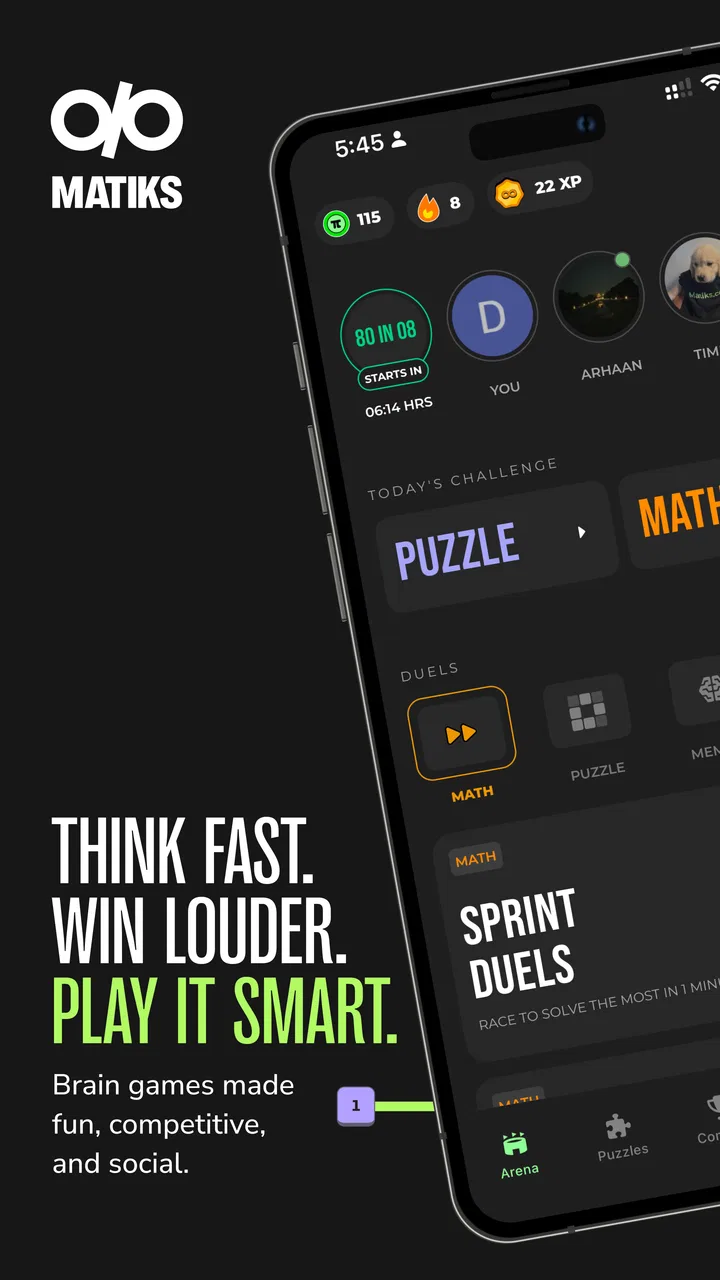
Matiks: Math and Brain Games
- 4.5
- Rating
- 1.00M
- Installs
- Free
- Price

 Analysis by App-foxy
I picked up Matiks: Math and Brain Games expecting a quick mental workout, and that is exactly where it makes the most sense. This free sports game from Matiks Developers turns short rounds of math, memory, and puzzle challenges into head-to-head duels. Rather than asking me to follow a long career mode or learn a complicated control scheme, it puts the focus on making a decision quickly, seeing how well it went, and deciding whether I can do better in the next round.
That simple structure is important. I can open it when I have a few spare minutes, play a focused challenge, and leave without feeling that I have abandoned a large campaign. At the same time, the competitive format gives the exercises more energy than a standard brain-training worksheet. My attention is not only on finding the answer; it is also on keeping pace and avoiding the small mistakes that appear when I rush.
The game is free and rated for Everyone, so it is easy to recommend as a casual option for families, students, or adults who want something more active than passive scrolling. It has also reached over a million installs and holds a 4.7 average from around twenty-two thousand ratings, which suggests that the short-duel idea has found a sizeable audience. I still would not call it a replacement for a full sports game or a structured learning course. Its appeal is narrower and more immediate: a repeatable mental contest that starts quickly and ends before it becomes a major commitment.
You May Also Like

 Google Keep - Notes and lists
Google Keep’s Quiet Growth Shows the Appeal of Simpler Notes
As mobile work gets busier, Google Keep keeps winning a simple contest: capture a thought quickly, find it later, and get on with the day.

 Blood Strike: 2.5 Anniversary
Blood Strike’s Loadouts Turn Every Drop Into a Tactical Gamble
A close look at Blood Strike’s custom loadouts: how fast access to signature weapons reshapes its battle royale rhythm, rewards preparation, and narrows the gap between fights.

 Pandora - Music & Podcasts
Pandora’s Music Is Easy to Start, but Harder to Recover
Pandora’s strength is its low-effort path from a seed to a station. Its weak spot is how much confidence it asks you to place in connection, setup, and quiet recovery.

 8 Ball Pool
 Is Built on Rivalries, Rematches, and Routine
A close look at the rivalries, rematches, shared routines, and unanswered safety questions that turn a quick pool match into a persistent mobile community.

 Samsung Music
’s Quiet Strength Is Playing What You Already Own
Its reach comes less from spectacle than from dependable access to a personal library. That simplicity is both the app’s strongest retention engine and its ceiling.

 AccuWeather: Weather Radar
AccuWeather Review: A Quick, Clear Forecast for Everyday Decisions
For everyday plans, the best forecast is the one you can understand quickly. AccuWeather makes rain timing, radar, and local conditions easy to act on, with a few trade-offs.
More From Our News Desk



How the first move sets up the whole experience
I use the opening move as a quick check of what kind of attention a round will demand, rather than rushing to answer as soon as the challenge appears. That small pause helps me choose a sensible pace and notice whether I’m alert enough for a competitive duel or better off stopping after one attempt. The next section looks at the practical checks that can make getting started smoother.
The opening challenge is deliberately easy to understand
The first thing I like about Matiks is that its purpose becomes clear without a long explanation. The three central styles—math, memory, and puzzles—give each session a recognizable identity. Math asks me to calculate or compare, memory asks me to retain information, and puzzles make me look for a solution under pressure. That variety keeps the game from feeling like I am repeating one worksheet with a new skin.
The first action in a round is usually straightforward: read the challenge, decide what matters, and respond. The simplicity is useful on a phone because there is little room for unnecessary interface friction. I do not need to manage a character, collect equipment, or learn a map before the actual test begins. The game gets to the mental task quickly, which is exactly what I want when I am playing during a short break.
That accessibility also explains why the Everyone rating feels appropriate. A younger player can understand the basic idea, while an adult can still find the time pressure and competitive framing engaging. The experience does not depend on specialist sports knowledge, so its sports classification is better understood through the duel-like format than through traditional athletic simulation.
Choosing the right mode for the moment
The three challenge families suit different moods. I choose math when I want a brisk test with an obvious right-or-wrong result. Memory works better when I am willing to slow down at the beginning and pay attention before acting. Puzzle rounds are the most useful when I want to think laterally rather than simply calculate. Switching between them is more valuable than forcing myself through one type after my concentration has faded.
One practical habit is to use the mode as a signal for my mental state. If I am distracted, I avoid treating a poor math result as proof that I have become worse at the game; it may simply mean I started too quickly. If I am tired, a memory challenge can expose that lack of attention more clearly than a familiar calculation. This makes each round feel like both a contest and a small check-in with my concentration.
The trade-off is that players looking for deep rules, elaborate tactics, or a large collection of sports mechanics may find the opening too modest. Matiks is not trying to simulate a match on a field. Its “sport” is the duel itself: prompt, response, result, and another attempt. That distinction is worth understanding before downloading it.
Why the first response matters more than it seems
In a normal puzzle book, I can pause indefinitely and inspect every possibility. Here, the duel framing changes my behavior. I tend to commit sooner, and that creates a useful tension between accuracy and speed. The best approach is not always to answer instantly. I get better results when I spend a brief moment identifying the operation, pattern, or memory detail before tapping.
This is one of the more useful non-obvious lessons in the game: the fastest answer is not automatically the strongest answer. A player who builds a tiny pause into the first action can avoid careless errors, then gradually shorten that pause as the format becomes familiar. That workflow makes the game feel less like random guessing and more like practicing a repeatable mental routine.
The feedback rhythm keeps a small round meaningful
What carries Matiks from one challenge to the next is the rhythm of action and feedback. I make a choice, receive an immediate sense of whether it worked, and then adjust my approach. Because the rounds are compact, the result does not feel buried under menus or a long loading sequence. A correct answer gives me a small lift; a mistake gives me a clear reason to reconsider my method.
That rhythm is more motivating than an isolated score at the end of a large session. I can identify the type of mistake while it is still fresh. In a math round, I may have rushed a simple calculation. In a memory round, I may have failed to notice a detail at the start. In a puzzle, I may have committed to the first pattern that looked plausible. The feedback becomes useful when I treat it as information about my process rather than as a judgment of my intelligence.
This is also where the duel format gives the game its personality. A solitary brain-training app can feel calm and private, while Matiks adds the pressure of comparison. That pressure is enjoyable when I want a contest, but it can be counterproductive if I am using the game specifically to relax. I would choose a quieter puzzle app for a gentle evening activity and Matiks when I want a sharper, more alert kind of break.
Turning mistakes into a better next attempt
I found it helpful to classify errors instead of simply replaying immediately. If I lose because I answered before understanding the prompt, I slow down at the start of the next duel. If I lose because I forgot a visual or numerical detail, I focus on creating a mental image or repeating the key information internally. If the puzzle itself confused me, I look for a different interpretation rather than pushing the same solution harder.
This approach gives the feedback a practical purpose. The game does not need a lengthy lesson after every attempt for me to learn something from it. The player has to supply some of that reflection. That is a strength for people who enjoy self-correction, but it is a limitation for anyone expecting a tutor that explains every incorrect answer in depth.
Another useful trade-off is speed versus consistency. Chasing a personal best can make the session exciting, but it can also encourage careless taps. I prefer to spend several rounds building reliable accuracy, then increase my pace once the task feels familiar. This produces a more satisfying improvement than repeatedly restarting after an avoidable mistake.
The reward is the feeling of a clean rematch
Matiks works best when the reward is understood as momentum rather than as a large collection of long-term prizes. A good response gives me the immediate satisfaction of winning a small contest, and a close loss creates a reason to try again. The game’s strongest reward is the sense that the next attempt could be better because the previous one revealed exactly where I slipped.
That loop is especially effective for short breaks. Imagine waiting for a kettle to boil or sitting down after finishing a small household task. I can play one duel without committing the next half-hour. If the round goes well, I get a quick mental lift. If it goes badly, I can either reset and test a new approach or close the game before the frustration grows. The session stays proportional to the time I actually have.
For students, the reward can be a change of pace between heavier tasks. I would not use it as a substitute for studying mathematics, because a fast game challenge is not the same as learning a syllabus. However, a few rounds can wake up attention before returning to homework. For adults, it can replace a few minutes of aimless social-media browsing with something that requires an active response.
The competitive reward is not equally useful for everyone. Players who dislike timed decisions or who become overly focused on losing may find the rematch loop stressful. In that case, the game is better used in moderation, with the goal of practicing attention rather than proving superiority. A different option, such as a noncompetitive logic game, may be a better fit for someone who wants complete control over pace.
Why variety matters more than endless repetition
Math, memory, and puzzle duels do not exercise attention in exactly the same way. That variety gives me a reason to continue after one type starts to feel predictable. It also prevents a single weak area from defining the entire experience. I may be confident with calculations but less reliable with memory, so changing modes keeps the game from becoming a narrow test of one habit.
There is a hidden benefit to rotating rather than grinding: the skills can interfere with one another in interesting ways. After a fast calculation round, I may carry that rushed mindset into a memory challenge and make an avoidable error. Switching modes encourages me to reset my approach instead of assuming that the same tempo works everywhere. That makes the game more mentally demanding than its simple controls suggest.
Still, variety does not mean unlimited depth. Players who want a carefully sequenced curriculum, detailed explanations, or advanced puzzle construction should look toward dedicated educational platforms or specialist puzzle games. Matiks is a compact collection of duel formats, not a replacement for a teacher, a textbook, or a deep strategy title.
The session reset is part of the design
A good short-session game needs a clean stopping point, and Matiks naturally creates one after a duel or a small run of attempts. I can decide that a result is good enough and put the phone down, or I can use the last outcome as the reason to begin again. That reset is central to the experience: the previous result matters, but it does not lock me into a long chain of consequences.
I like this because it keeps failure manageable. A bad round does not require me to protect a campaign, recover a virtual team, or wait for an energy system to refill. I can treat it as a single experiment, change my method, and start over. The downside is that players who need a strong narrative or a persistent world may find the reset too light. There is less emotional investment than in a traditional sports career mode.
My best routine is to set a personal stopping rule before opening the game. I might play until I complete one focused set, or stop after two rushed mistakes rather than continuing while irritated. This is a small but important tip: because the loop makes another session feel immediately available, it is easy to keep chasing a better result longer than intended. A stopping rule preserves the game’s value as a quick mental break.
Who will get the most from it
I would recommend Matiks to people who enjoy quizzes, quick logic tests, and friendly competition but do not want the complexity of a full sports title. It is a particularly good match for players who like visible feedback and can motivate themselves with a near miss. Families may also appreciate that the core challenges are understandable without requiring knowledge of a specific sport.
It suits short, repeatable use better than long uninterrupted sessions. The game is easy to fit around a commute, a break between appointments, or a pause before bed, although players who find mental competition stimulating may prefer not to use it when they are trying to wind down. Its free price removes the main barrier to trying it, and the Everyone rating makes it broadly approachable.
I would skip it if my priority were a realistic sports simulation, a rich single-player campaign, or a comprehensive educational program. I would also look elsewhere if I wanted detailed explanations after every answer or a completely pressure-free pace. Matiks earns its place through quick duels and repeat attempts, not through depth in any one of those areas.
Device expectations and current position
The game runs on Android devices using version 7.0 or later, which makes it accessible to people who are not carrying a recent phone. The current version is 1.22.100, so anyone installing it should make sure the device meets that basic system requirement before expecting to play. I appreciate that the entry point is not tied only to flagship hardware, especially for a game whose appeal comes from quick access rather than demanding visual presentation.
Matiks was released on August 19, 2024, and its audience has already grown beyond a million installs. Those figures do not guarantee that every player will enjoy the same modes equally, but they do make the game feel established enough to consider as a regular casual download rather than an obscure experiment. The 4.7 average from around twenty-two thousand ratings is encouraging, while the smaller body of written feedback means I would still judge the experience personally after trying several different challenge types.
The developer, Matiks Developers, has chosen a focused concept instead of combining brain games with a large collection of unrelated systems. That focus is a strength when I want to open the app and begin thinking immediately. It is less convincing for players who expect constant progression, customization, or a detailed competitive ecosystem.
My verdict on the complete action-feedback-reward-reset loop
Matiks succeeds because its loop is easy to feel: I take an action, receive a result, enjoy the satisfaction of a good answer or the irritation of a close mistake, and then decide whether the next attempt deserves another minute. Math, memory, and puzzle challenges give the loop enough variation to remain inviting, while the duel format adds urgency without requiring complicated controls.
My main reservation is that the same simplicity can become limiting. The game depends on the player creating personal goals and learning from mistakes. Someone looking for a deep progression system or formal instruction may finish a few sessions and want more structure. Someone who enjoys quick mental contests, however, will understand why another round is tempting: the reset is immediate, the challenge is familiar, and the last result always feels slightly unfinished.
For me, that makes this a worthwhile free sports game for short bursts of active attention. I would keep it on my phone for moments when I want to replace passive scrolling with a compact challenge, and I would recommend rotating between the three modes rather than repeating only the easiest one. Its best quality is not that every round is profound; it is that each round gives me a clear reason to think, respond, and try once more.
FAQs for Matiks: Math and Brain Games
01What types of games are available in Matiks: Math and Brain Games?
Matiks offers a diverse range of games designed to boost your math skills and cognitive abilities. The app includes puzzles, arithmetic challenges, and logic games that cater to different skill levels. Whether you’re looking to improve your calculation speed or enhance problem-solving skills, there’s something for everyone.
02Is Matiks suitable for all age groups?
Yes, Matiks is designed to be user-friendly and beneficial for all age groups. The app provides varying difficulty levels, ensuring that children, teens, and adults can all find challenges that suit their cognitive development and mathematical understanding. It’s a great tool for learning and entertainment for the whole family.
03Does Matiks require an internet connection to play?
Matiks can be played both online and offline, offering flexibility for users. While some features, like leaderboards or updates, may require an internet connection, all core gameplay can be enjoyed without one, making it perfect for use on the go or in areas with limited connectivity.
04Are there any in-app purchases or ads in Matiks?
Matiks is free to download and offers a range of free content. However, it does feature optional in-app purchases for additional games or features and contains ads. Users can choose to purchase a premium version to remove ads and unlock exclusive content, enhancing their gaming experience.
05How does Matiks help improve cognitive skills?
Matiks is designed with educational techniques to boost cognitive functions such as memory, attention, and problem-solving. By engaging in various math and logic puzzles, users can improve their numerical fluency and enhance brain activity. Regular use of the app can lead to noticeable improvements in mental agility and mathematical skills.
Pros
- Engaging puzzles enhance cognitive skills.
- Variety of games keeps it interesting.
- User-friendly interface for all ages.
- Offline mode available for on-the-go play.
- Regular updates with new challenges.
Cons
- Some games require in-app purchases.
- Ads can be intrusive at times.
- Limited free content without subscription.
- Graphics could be more appealing.
- Occasional bugs in older devices.

Matiks: Math and Brain Games
Gallery